Showing posts with label Power generation. Show all posts

Tuesday, 13 November 2018

STATIC VAR COMPENSATOR (SVC)


Static VAR compensator:


The static VAR compensator is also known as SVC. The SVC is a shunt compensator FACTS device. The SVC is a generator or absorber which is used to exchange the capacitive and inductive current from the power system. By this way, it can control and maintain a specific parameter of the system. The SVCs can draw reactive power from the line and improve stability, control over voltage, reduce voltage flickering and regulate voltage. It has capacitor bank fixed or controlled (switched) or fixed capacitor bank and switched reactor bank in parallel. The thyristors are used to control and switching (on & off) of capacitor and inductor. So, it is also known as static VAR switches because it uses switching for VAR control.


For step-wise control of the capacitor and reactor, thyristors in anti-parallel connections are used. In this devices capacitor and reactor unit act as continuously variable in power system, this can be done by controlling of firing angle of thyristors.
There are four schemes for static compensation;
                1) Saturated reactor
                2) Thyristor controlled reactor (TCR)
                3) Thyristor-switched capacitor (TSC)
                4) Combined TCR and TSC compensator
SVC is placed to solve below problems in power system;
* Voltage flickering caused by varying high reactance load like arc furnace
* Transient stability limit
* Power transfer capacity of the transmission line
* Temporary over-voltage in the transmission system
* Regulate the voltage
* To improve power quality
                The SVCs are placed near high and rapidly varying load in industries like arc furnace.

1) Saturated reactor:

                The saturated reactor is a constant voltage reactive source. This is not very flexible with respect to the operating characteristic. This is nothing but a multi-core reactor and the phase winding is arranged to cancel the principal harmonics.

2) Thyristor controlled reactor (TCR):

                It consists of a six-pulse or twelve pulse thyristor-controlled reactors and a fixed shunt capacitor bank. By adjusting the firing angle of the thyristor, the reactive power can control. The control system consists of a voltage and current measuring devices. Filters are used to provide fixed reactive power and absorb the harmonic current generated by TCR. The TCR is used to continuous control of the electrical power system.

3) Thyristor-switched capacitor (TSC):

                It consists of a thyristor-switched capacitor bank. This capacitor bank is split into a number of units to achieve a step-wise control. All the units have an equal rating. By full or zero conduction operation of thyristor valve, the effective resistance of TSC can be varied in a step-wise manner. For effective reactance calculation, we have to consider fully connected or fully disconnected capacitor.

4) Combined TCR and TSC compensator:

                A continuously variable reactive power can be achieved by using a TCR in combination with TSC. A continuous change in the control order from fully lagging to fully leading current is obtained by this combination. By using a different combination, an SVC can get various requirements to absorb/supply reactive power from/to the power system.


Advantages of SVCs:

1) It gives fast response to change in power system
2) Less costly, high capacity, faster and more reliable
3) It reduces harmonics and voltage fluctuations
4) It provides load balancing function
Monday, 12 November 2018

POWER FACTOR

Power factor:

In power system, three quantities are most important;
                1) Voltage
                2) Current
                3) Frequency
Power quality is an important concern in the power system because it affects the voltage, current, and frequency. The power factor is an important aspect for improving power quality of supply. A load with low power factor has good efficiency and it can save a considerable amount of cost. For, this reason, majority of the utility companies demand in the reduction of reactive power. If reactive power demand decrease, the power factor will improve.
 There are three types of power;
                1) Apparent power
                2) Active power
                3) Reactive power

 1) Apparent power: 

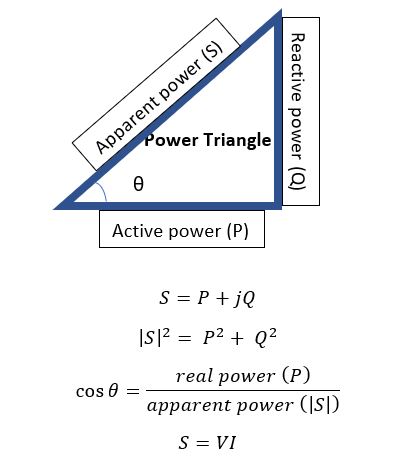
                               The apparent power is denoted as ‘S’. It is the product of the RMS voltage and current. Volt-amperes or VA is unit of the apparent power.
                                S = V x I                 for single phase apparent power
                                S = 1.73 V x I       for three phase apparent power
                                                                                Where V is phase voltage and I is line current


2) Active Power:

                               The active power is also known as true power or real power. This power is a useful power for the load. The unit of the active power is WATT (W) and it is denoted as P. WATT is a very small unit, so power is measured in kW or MW. The active power is carried out in the power system by the part of the current. This current is always in phase with the supply voltage. The real work cannot be done when the current is out of phase with the supply voltage.
3) Reactive power:  
                              The reactive power is a part of an apparent power which is out phase with the real power. This is happening in the power system by reactive elements like inductors and capacitors. This power does not use for the load. The reactive power is also known as the imaginary power. The unit of the reactive power is volt-ampere-reactive (VAR).

Power factor: 

                               The power factor is the ratio of active power (true power) to the power supplied by the power system (apparent power).
                                POWER FACTOR = REAL POWER / APPARENT POWER
                                                                          PF = P/S
In power triangle, θ is the angle between current and voltage. Power factor is also defined as the cosine angle between the phase voltage and the line current.
                                                                             PF = cos θ
Power factor is a dimensionless quantity. The range of power factor is between -1 to 1. In an ideal power system, the power factor is unity (1), means that there is only real power is available. There is absent of reactive power. But in the actual power system, we can not ignore the reactive power and it always is present in the power system. So, in the actual power system, the power system can not unity, but for good quality of supply, we try to maintain power factor near to the unity.
In the power system, we use FACTS devices to improve the power factor. 

Monday, 4 June 2018

Different Sources of Energy for Power Generation


Different Sources of Energy for Power Generation

Power system is divided into three parts; power generation, transmission and distribution. In this article, we will discuss about power generation. actually, in power generation, one form of energy will convert in to electrical energy. Electrical energy is produce from various natural sources. These sources are classified into two types; renewable sources and non-renewable sources. In present power system, most of electrical energy is generate from non-renewable sources like coal, oil and natural gas. But these sources are available for short period of time. We have to use these sources as minimum as we can and we have to find an alternate source or move on renewable sources. In renewable sources includes the solar, wind, water, tidal and biomass. These sources are environment friendly, free and infinite resource available. let’s get more information about renewable sources.

Solar: It is a best alternate source for power generation. there are two ways, to generates electrical energy from sun light.
    1) Electricity is directly generating by using photovoltaic (PV) cell. The photovoltaic cell is made up of silicon. Number of cells are connected in series or parallel and makes a solar panel.
      2)  Heat (solar thermal) is generating with the help of mirrors and this heat is used to convert water into steam. This high temperature steam is used to rotate turbine.

Advantages:
      1)    Transmission cost is zero for stand-alone solar system.
      2)    Environment friendly
      3)    Maintenance cost is low
      4)    It is ideal source for remote locations that cannot be tied to the grid

Disadvantages:
      1)    Initial cost is high
      2)    Require large area for bulk production
      3)    Whether dependent
      4)    Solar energy storage (battery) is costly


Wind: Wind turbines are used to convert wind energy into electrical energy. Wind is created by temperature change in atmosphere. Wind energy is convert into kinetic energy. Kinetic energy is given to the induction generator and it converts it into electrical energy.

Advantages:
       1)    Generate energy in remote locations
       2)    Wind energy is an unlimited, free and clean source of energy.
       3)    Operating cost is almost zero

Disadvantage:
       1)    It makes noise
       2)    Poses threat to birds
       3)    It needs big open area
       4)    Expensive construction process.
       5)    It cannot produce the same amount of electricity for all time
       6)    Lower electricity output

Hydro: The power obtained from river or ocean water is called hydro power. Hydro-power plants are works based on the gravitational effects. Water is stored in dam or reservoir, movement of this water as it flows downstream towards the penstock and water gains kinetic energy that is use to rotate turbine.

Advantages:
      1)  It can be use in the service instantly.
      2)  After this process, water can be used for irrigation and other purpose.
    3) Dams are designed for long period of time and so it can contribute to the generation of electrical energy for many years.
     4)  Running cost and maintenance cost is low
     5)  No fuel transportation is required.

Disadvantages:
      1)    Initial cost of power plant is high
    2)    Hydro power plants are located at hilly area and it is very far from the load. So, they require long transmission line
      3)    Construction of dams can flood towns and cities
      4)    Whether dependent

Coal: Thermal power plant produce electricity by burning of coal in the boiler. Heat is used to convert water into steam. This high pressure and high temperature steam flows into the turbine and spins a generator to produce electrical energy. After it passes through the turbine, the steam is cooled in condenser and reuse in boiler to generate steam. Thermal power plant works according to Rankine cycle.

Advantages: 
      1)    Coal is cheap
      2)    Less initial cost compares to renewable power plant
      3)    Require less space
      4)    It can be install at any place. Because coal can be transport to plant.
      5)    Construction and commissioning of thermal power plant takes lesser time

Disadvantages:
      1)    Coal is non-renewable energy source
      2)    Operating cost high and variable according to price of coal
      3)    It pollutes the atmosphere due to smoke and fumes
      4)    Huge requirement of water

Nuclear: Working of nuclear power is almost same as thermal power plant. In thermal power plant, coal is used in boiler to produce heat. In nuclear power plant, uranium is used in reactor to produce heat. In both power plants chemical energy is converts into electrical energy. 1 kg of uranium can produce energy same as the energy produce by burning of 4500 tonnes of coal or 2000 tonnes of oil.

Advantages:
       1)    Less space requires
       2)    It can produce very high amount of electrical energy from single plant.
       3)    It does not emit CO2
       4)    Nuclear power plant need less fuel

Disadvantages:
       1)    High initial construction cost
       2)    High operating and maintenance cost
       3)    Radioactive waste
       4)    High risk 

Installed capacity in India:

Yearly gross electricity generation by source (GWh) (2016-2017)
Source
Generation (GWh)
Coal
944,861
Oil
275
Gas
49,094
Diesel

Nuclear
37,916
Hydro
122,313
Mini hydro
7,673
Solar
12,086
Wind
46,011
Biomass
14,159
(source: wiki)

Wednesday, 7 March 2018

Sunday, 4 March 2018

Saturday, 3 March 2018

Nuclear power plant

Nuclear power plant:
      A nuclear power plant is converted atomic energy into electrical energy. The atomic energy is stored in radioactive fuel like Uranium, Thorium. In a nuclear power plant, atomic energy is transferred into thermal (heat) energy and the water are converted into the steam. After that working is same as the thermal power plant. Difference between the thermal power plant and nuclear power plant is the way to generate heat energy and fuel. In a thermal power plant, Coal is used as fuel and in a nuclear power plant, Uranium is used as a fuel. By nuclear power plant, around 10% of total electrical energy is generated.

          In a nuclear power plant, heat is generated by nuclear fission. The radioactive elements are used in this process. Generally, Uranium (U235) and Thorium (Th232) is used as fuel in a nuclear power plant. The fission of 1 kg uranium produces heat which is equal to heat produced by 4500 tons of high-grade coal. So, the big challenge is to control the amount of heat produced by fission in a nuclear reactor. This large amount of heat is transferred to the reactor coolant. For coolant, water, gas, or liquid metal is used. The high-temperature coolant is used to convert water into steam. But, the coolant contains a small amount of radioactive element. That’s why heat exchanger is used to transferring heat from coolant to water. The heat exchanger is used to transfer heat without getting a direct touch. This high-temperature steam is used to rotate the steam turbine. The alternator and steam turbine are connected to the same shaft and generates electrical energy.


Components of Nuclear power plant:

1) Nuclear Reactor: In a nuclear reactor, atomic energy is converted into thermal energy. The heat is produced in the nuclear reactor. This heat is produced by the fission process of a radioactive element. A large amount of heat is generated by the fission. This heat is transferred to the coolant. Two types of nuclear reactors are available. First is Pressurised water reactor (PWR). In this type of reactor, the produced heat is transferred to coolant with the help of heat exchanger. So, in this case, radioactive element and coolant cannot come in direct contact. But, in case of Boiling water reactor (BWR), the heat exchanger is not used and heat is transferred directly to the coolant. In this case, some amount of radioactive element come in contact with the steam (from heat) and it may get damage turbine blade.

2) Heat exchanger: Heat exchanger is used for transferring heat from one medium to another medium. In a nuclear power plant, the heat exchanger is used to transfers heat from the coolant to the water. In Boling water reactor, the heat exchanger is not used.

3) Coolant: Coolant is used to transfer heat. The water, heavy water, gas (CO2, helium), liquid metal (Na) are used as a coolant. The coolant is transferred a large amount of heat from reactors and keep reactor at a safe temperature. Coolant must be non-corrosive, high chemical and radiation stability, non-toxic, non-oxidising and it must not absorb neutrons.

4) Steam turbine: High-temperature and high-pressure steam are passed to the turbine. In a steam turbine, thermal energy is converted into kinetic energy.

5) Alternator: Alternator and steam turbine both are connected to the same shaft. So, alternator rotates at the speed of the turbine. In an alternator, kinetic energy is converted into electrical energy.


Advantages:

1) It requires less space compared to another power plant.

2) It requires a very small quantity of fuel. So, fuel transportation cost is less.

3) It does not require a large amount of water.

4) It is not affected by weather conditions.

5) Less manpower is required compared to the thermal power plant.


Disadvantages:

1) It requires well-trained operators.

2) It is not suitable for varying load conditions.

3) Very high initial cost.

4) It has an adverse effect on the health of population surrounding of the plant if radioactive 
waste is not carefully disposed of.

Thursday, 11 January 2018

Solar PV plant

Solar power plant:

The solar power plant is used to convert sunlight into electricity. The sun light is freely available and environment-friendly source. We can generate electricity with the help of solar by two ways. One way is with the help of photo-voltaic panels and the second way is with the help of mirrors. Out of these two methods, the first method is an efficient and easy method to generate electricity.

By using photo-voltaic cells, sunlight can be converted into electrical energy. This type of electricity generation method is very popular in present and it will be more popular in future. Because this method uses non-renewable energy source (sun light) and this source is freely available for a lifetime. The coal and other non-renewable sources like gas, diesel are not available in future. So, this will take place of all thermal power plant and it will be an alternative source of this non-renewable sources.

Components used in Solar plant:

           1) Solar PV panels
           2) Inverter
           3) Charge controller
           4) ACDB and DCDB
           5) Battery (Optional)

1) Solar panel:
         Solar panel is a main part of solar plant. The cost of solar panel is almost 75% of total cost of plant. Solar panel is made from number of solar cells (PV cells). These cells are connected in series and parallel according to voltage requirement. Generally, PV cells are made up from silicon. Solar cells are used to convert solar energy to electric energy. Three types of solar panels are available in market.
                A) Crystalline PV module: In Crystalline PV module, we can make two types of arrangement; single crystalline (mono crystalline) and multi crystalline (poly crystalline). The poly crystalline has lower efficiency compared to mono crystalline but cost of mono crystalline is high. Both PV module has high conversion rating (convert solar energy to electrical energy) around 12-18 % and life of both module is also very high.
                 B) Amorphous silicon PV module: This PV module is also known as thin-film PV module. This module is thin compare to crystalline module. But, this module is used where high efficiency is not consideration but cost is more consideration. The conversion rate of this module is just 6-10 % which is lower compared to crystalline module.
                C) Hybrid PV module: In this type of module, crystalline cells are surrounded by thin-film of silicon. So, this is a combination of both type of PV module. The efficiency of this module is very high and conversion rate of this module is around 20%.   

2) Inverter: Output of solar panel is Direct current (DC). The inverter is used to convert this DC power into AC power because our load (AC, fan, light (residential), commercial and industrial) is works on AC power. So, we require AC power.  

3) Charge controller: The charge controller is used to maintain the proper output voltage for the system voltage. If battery-bank is used for back up, than charge controller plays an important role to regulate the voltage and preventing of overcharging of battery and allowing charging when it required.

4) ACDB and DCDB: ACDB is known as AC Distribution Box, which is placed at AC part of the system (after inverter) and DCDB is known as DC Distribution Box, which is placed at DC part of system (before inverter). These devices are use for the protection purpose and contains MCB/MCCB and SPD (Serge protection device) and a plastic/metallic box.

5) Battery: The battery is an option part of solar system. According to installation type, two types of solar plants are available; grid connected and stand alone. In grid connected solar pant, access amount of energy will transmit to the utility and need not to connect battery for back up. But, in case of stand alone system, where grid is not available, in this condition, we have to use battery for store access amount of power and for back up.    

Advantages of solar power plant:

1) They help in keeping the environment pollution free and Help in generating electricity easily with good efficiency.

2) The initial installation of the solar power plant is expensive due to the advancement in technology the price of these plants is dipping down. Because of advancement and help of the government of India, solar power is available at only 3 ₹/kWh (including subsidy. Which is the lowest price comparing to other sources.)

3) It is a great way to save money as most of the electricity is consumed from the power plants it can help you to reduce bills.

4) As solar power is a renewable source of energy is available free of cost everywhere.

5) It can be used for lighting, mobile charging, security cameras, park lighting.

6) When there is no power you can use the electricity generated from the solar power plant and solar power plant requires very low maintenance and at the same time have a long life of panels and other accessories.

7) It works in the best way when the location is a remote area.